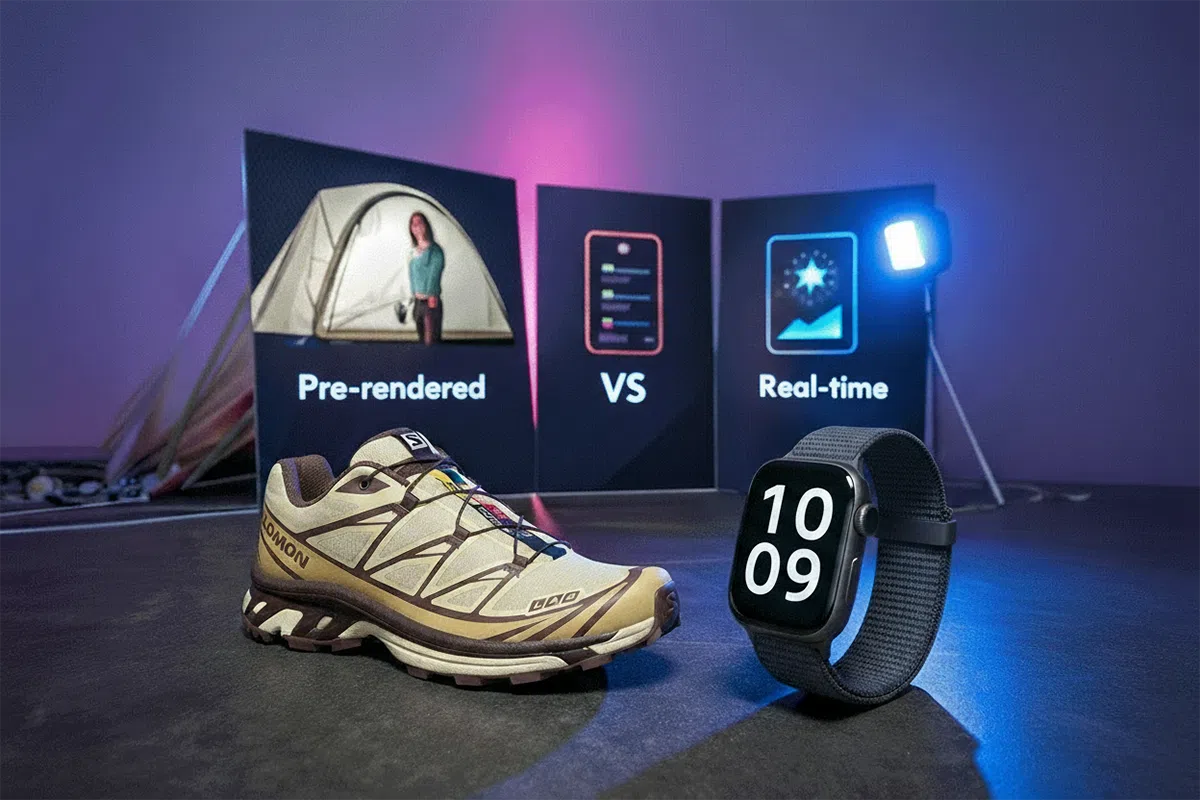
In 3D, two rendering approaches coexist: pre-rendered and real-time. The former pursues visual perfection by computing every frame in advance for cinema-grade realism. The latter prioritizes interactivity and responsiveness, generating images instantly at every move or interaction.
At Power.xyz, both dimensions are combined to deliver fluid, photorealistic, and engaging product experiences accessible from any browser.
How it works
In real time, the 3D engine runs a full pipeline every frame: state updates, GPU processing, shaders, and post-processing effects. This architecture sustains consistent smoothness between 30 and 120 frames per second depending on the device. In pre-rendered workflows, images are computed ahead of time using advanced physical methods (path tracing, multi-bounce global illumination, subsurface scattering, caustics), often distributed across render farms. The result: impeccable image quality, ideal for campaign visuals and hero content.
How Power.xyz leverages both worlds
Our approach hybridizes the two models.
We use real-time 3D to let users configure, explore, and interact with the product directly on the web.
In parallel, we rely on pre-rendered output to produce ultra-detailed static visuals for e-commerce pages and brand campaigns.
This dual use ensures our partners benefit from:
- Increased creative agility through instant real-time visualization,
- Visual consistency across all channels (website, retail, campaign, XR),
- Optimized 3D production costs and timelines through unified workflows.
Concrete use cases
- Social media: Ability to create a pre-rendered asset that can then be integrated into an AI-generated environment (see Virtual Studio).
- Luxury and fashion: a piece of jewelry or a bag rendered with cinema-grade fidelity for communications, yet interactive on the product page. (for example the ring that can be seen here in the gallery here)
Challenges and solutions
At Power.xyz, we address the main challenges of both approaches:
- Quality/performance gap: automatic calibration of shaders and post-processing per distribution channel.
- Material/lighting consistency: centralized control via a “master material system” ensuring identical output across engines.
- Pipeline optimization: automated versioning, levels of detail (LODs), and denoising to keep 3D flowing continuously.
- Scalability: cloud integration and on-prem GPU to scale computing power based on demand and precision needs.
When to choose real-time, pre-rendered… or both
Choose real-time when interactivity, personalization, and speed are critical. Choose pre-rendered for prestige visuals or shots where every pixel counts. Combine both to maximize visual impact and operational performance. This combination is exactly what we deploy at Power.xyz to deliver the best of both worlds to brand partners. Toward unified 3D experiences The line between real-time and pre-rendered is fading. Advances in real-time ray tracing, hybrid denoising, and GPU optimization are bringing cinema-level rendering closer to interactive experiences.
At Power.xyz, the future lies in unified pipelines, coherent master assets, and multi-platform deployment. Each channel web, retail, XR, media receives the best version of the same content, without unnecessary duplication. This is how we reinvent 3D creation and distribution for brands, combining technological power with visual emotion.